
5AM wakeup. From upstairs come the cries of my daughter, who’s fallen ill during the early morning hours. We have a minor flood in the house because of a clogged toilet, backed-up laundry to the ceiling, two car inspections due, federal income taxes to start, husband out of town for work. Oh, and a jury summons came in the mail yesterday.
And then sometimes, fate says “this bitch seems bored” and throws me for a real loop.
Somewhere in the middle of this, I’m supposed to be finishing a book.
As a creative, it’s often hard to dedicate time to your craft when life pulls you in the opposite direction. And even if there’s time in the day to write, sometimes my spirit is too weary to start. Overwhelm is especially dangerous because no one is making you do the work. There’s no boss standing over your shoulder telling you to write your book, finish your painting, or start your business. If you get overloaded and shut down, the only thing that disappears is your dream—and it disappears quietly.
What helps me focus and stay on track is intention. As the mother of special needs twins who are rarely predictable, I’ve learned to think on my feet. I’ve developed a simple but powerful way to deal with my overwhelm and chip away at my goals on a daily basis. (And no, I’m not about to sell you anything. Everything here is free information.)
Lists. I want you to start keeping lists.
I know it sounds too simple. But hear me out.
Here are the five lists I keep on my phone:
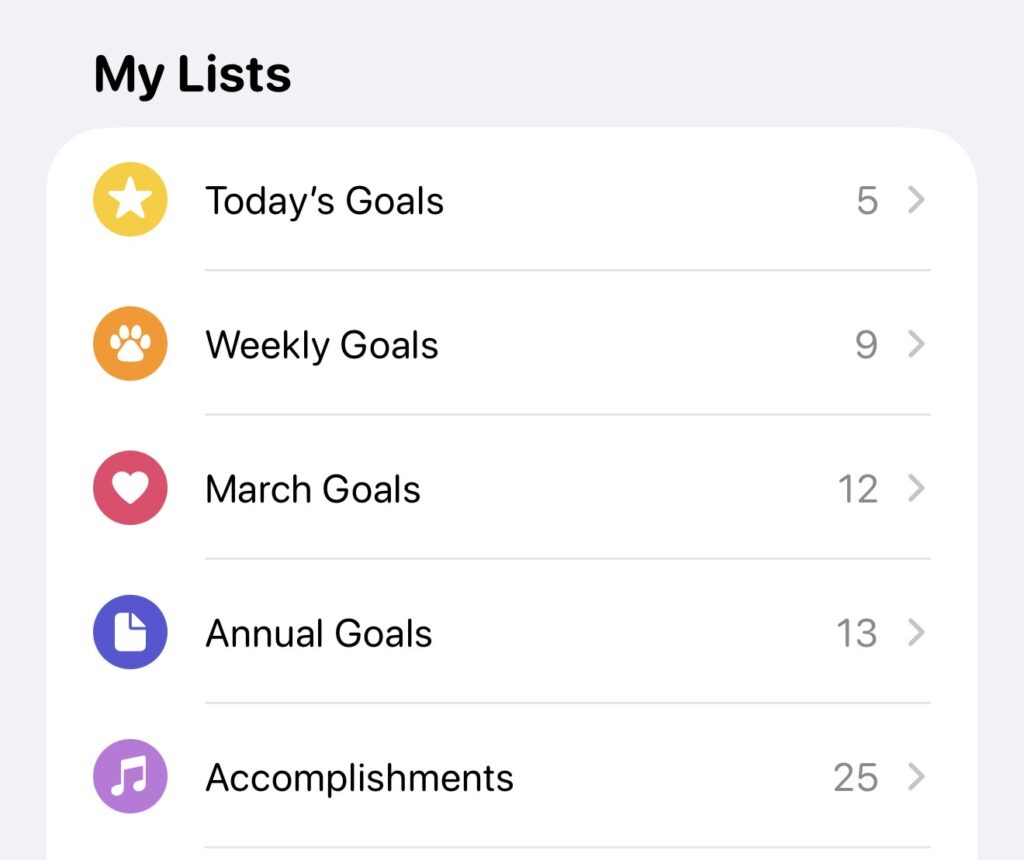
For those who can’t see the above picture, the lists are: Today’s Goals, Weekly Goals, Monthly Goals, Annual Goals, Accomplishments.
I use the Reminders app, which is free and comes preloaded on the iPhone, but feel free to use whatever works for you. I suggest something that allows you to tick off tasks as you complete them.
That last list (Accomplishments) is hugely important. Don’t leave it out!
Annual Goals
This list is not for pressure. It’s for direction.
Start here before tackling anything else. List out everything you want to accomplish for the entire year. It doesn’t matter if you’re starting in January or August. Just list out your remaining tasks for the year. All of them. An example task for a writer might be: Finish draft 1 of my manuscript.
Since I have more going on in my life than just my writing career, I like to include hobby goals, household projects, desired vacations, the number of books I’d like to read by the end of the year, etc. It keeps me balanced and on track with multiple avenues of life. So I might include things like: Read 36 books, Redecorate my house, Learn how to knit.
Just remember. BIG goals go here. Not the individual steps.
And make sure all of these goals are pointing toward the life you want. Your dream career, that perfectly curated library, a nice home that makes you feel peaceful. All the things that make you sigh and say, “I wish I had this.” Let’s start making it happen.
Because your annual list is too overwhelming to tackle all at once, right? Move instead to your monthly list.
Monthly Goals
This is where dreams start turning into plans.
Refer to your annual list, pick out which goals you’d like to tackle for the month, and break them down into small steps. My annual goal was to finish an entire manuscript. I can’t do that in a month, so my monthly writing goal might be: Finish act 1 of my manuscript.
For the other areas of my life, I might include goals like: Read 3 books, Refresh living room decor, Research knitting – tutorials, supplies, groups.
It’s okay to start listing out individual steps here, but don’t go too crazy yet. That’s for the next list.
Weekly Goals
This is where plans start turning into real progress.
Refer to your monthly list and select the items you can realistically accomplish in a week. If something doesn’t get done, no sweat. It’s still on the monthly list. You can attack it next week. My weekly writing goal could be: Finish chapter 1&2 of my manuscript.
For my greater life goals: Finish this specific book, Purchase a new rug and pillows for the living room, Frame and hang artwork, Purchase knitting supplies, Join this specific knitting community.
This is a great place to also add impromptu reminders for myself like Dog Grooming @ 9am on Tuesday — or Buy Easter baskets for the kids. Slowly, your huge list of annual goals starts taking shape in real life—as tiny, digestible steps that move you in the right direction.
Daily Goals
This is where overwhelm loses and momentum wins.
These are the things that need to get done ASAP. My daily writing goal might be: Fix the opening scene in chapter 1, flesh out scene 2.
I also directly pull tasks from my weekly goals, as if to say, “This is what I’m narrowing my focus on today. The rest can wait for tomorrow.” Perhaps it’s the perfect day to shop for your redecoration project, and not the right day to write until tomorrow. Account for that.
This is also the perfect place to remind yourself to go grocery shopping or walk the dog.
When you tick off a daily goal, see if you can tick off a related weekly goal as well. And when a larger project is complete, then you can tick off the monthly and annual goals!
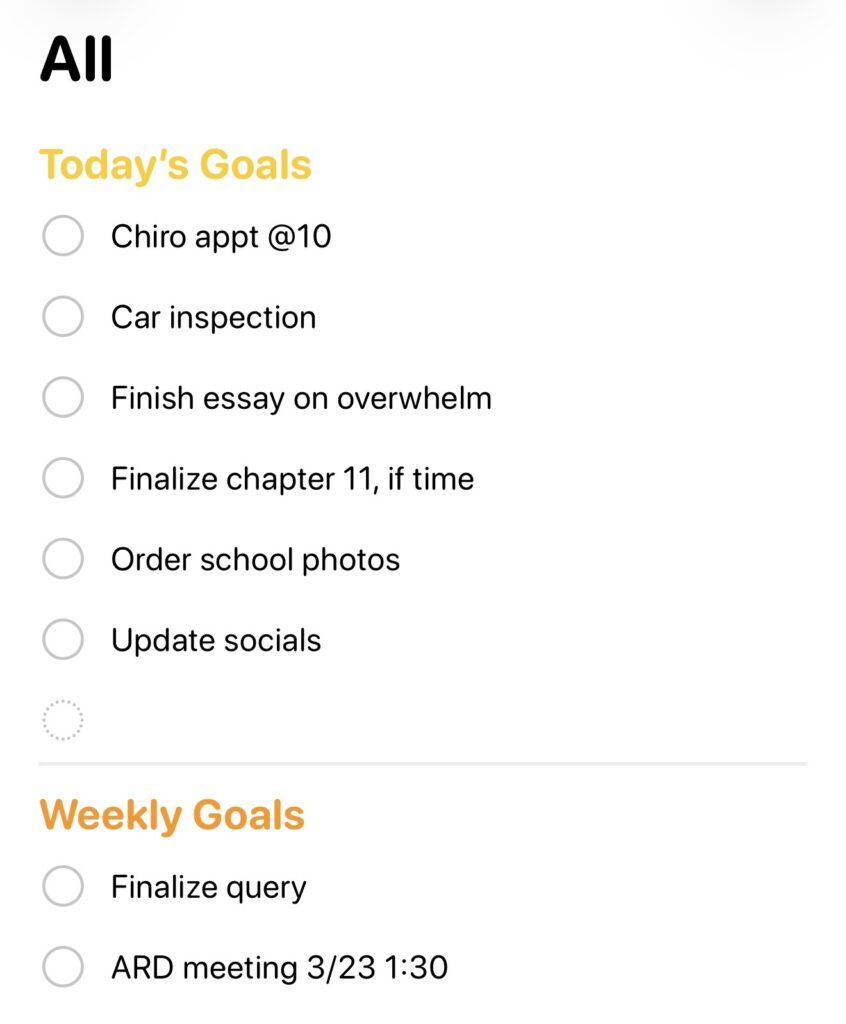
Here’s an example of what this looks like in practice. (The weekly goals continue past the screenshot. Just wanted to give you a general idea.)
Accomplishments
Do not skip this list. It’s so, so rewarding.
Creatives are notoriously bad at remembering what they’ve accomplished and very good at remembering what they haven’t. This list fixes that.
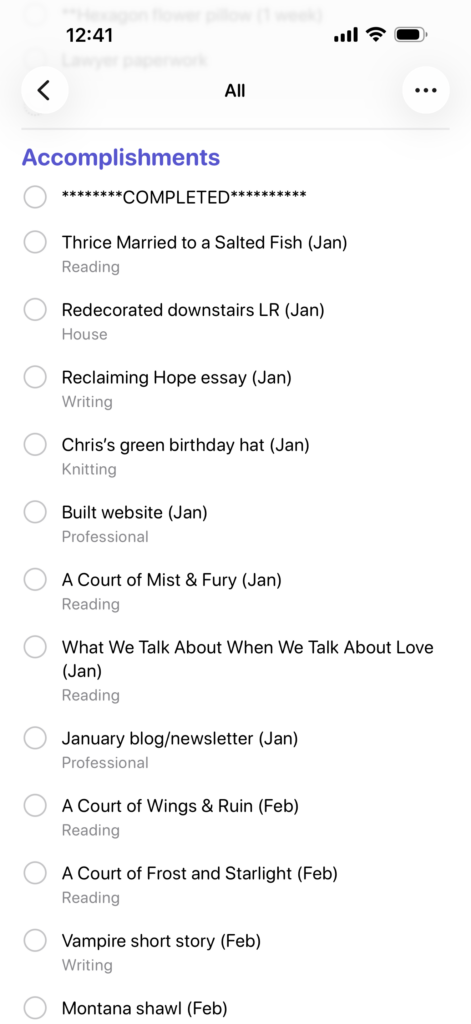
Whenever I complete a monthly or annual goal, I add it to this list to keep track of everything I’ve done for the entire year. And let me tell you, it is satisfying to get to December 31st, look back, and see that you weren’t as unproductive as you thought. No, you read 36 books—here are the names—and you finished 2 drafts of your book. You knitted a cardigan and reorganized every room in your house.
All because you broke down a dream into tiny steps.
Remember, you don’t have to build your dream life in a day. You just have to decide what today is for.
Featured image by Luis Villasmil on Unsplash